Affichage des articles dont le libellé est International. Afficher tous les articles

lundi 28 mars 2016

There's a First World. There's a Third World. Is There a Second World?

There's a First World. There's a Third World. Is There a Second World?
We often hear about the plights of the Third World, and most of us have our share of First World problems. But is there something in between—a Second World?
There sure is: the Commies (and now former Commies).
Today, people use the terms First or Third World to rank the development of countries or the strength of their economy. This is a pretty recent development, and veers away from the original usage of the terms, which were coined during the Cold War as part of a rough—and now outdated—model of geopolitical alliances.
The Cold War and the creation of NATO (a military and collective defense alliance formed by the U.S. and its western allies) and the Warsaw Pact (a defense treaty between several communist states in Eastern Europe) roughly divided the major world powers into two spheres with differing political and economic structures—east versus west, communist versus capitalist, the U.S. versus the USSR—with the Iron Curtain in between them.
In 1952, the French demographer Alfred Sauvy coined the term “Third World” to refer to everyone else, the countries unaligned and uninvolved with either side of the Cold War division. With the naming of the Third World, it followed that the Cold War blocs should get numbered, too. The democratic, capitalist countries within the Western sphere of influence became the “First World." The communist-socialist states that were part of or allied with the USSR became the "Second World."
Later, the term "Fourth World" was coined to refer to ethnically or religiously defined populations living within or across national boundaries, nations without a sovereign state, and indigenous groups that are nomadic, uncontacted or living outside of global society.
THE WORLDS TODAY
At the end of the Cold War, the three worlds model (not to be confused with Mao Zedong’s differently structured Three Worlds Theory) took on more of an economic context, rather than a geopolitical one. The First World now usually refers to Western, industrialized states, while the Second World consists of the communist and former communist states. The Third World still encompasses “everybody else,” mostly in Africa, Asia, and the Middle East, and tends to be a catchall for “developing nations” that are poor, less technologically advanced, dependent on the “developed countries,” or have unstable governments, high rates of population growth, illiteracy and disease, a lack of a middle class, a lot of foreign debt, or some combination thereof.

Third World

Third World
The economically underdeveloped countries of Asia, Africa, Oceania, and Latin America, considered as an entity with common characteristics, such as poverty, high birthrates, and economic dependence on the advanced countries. The French demographer Alfred Sauvy coined the expression ("tiers monde" in French) in 1952 by analogy with the "third estate," the commoners of France before and during the French Revolution-as opposed to priests and nobles, comprising the first and second estates respectively. Like the third estate, wrote Sauvy, the third world is nothing, and it "wants to be something." The term therefore implies that the third world is exploited, much as the third estate was exploited, and that, like the third estate its destiny is a revolutionary one. It conveys as well a second idea, also discussed by Sauvy, that of non-alignment, for the third world belongs neither to the industrialized capitalist world nor to the industrialized Communist bloc. The expression third world was used at the 1955 conference of Afro-Asian countries held in Bandung, Indonesia. In 1956 a group of social scientists associated with Sauvy's National Institute of Demographic Studies, in Paris, published a book called Le Tiers-Monde. Three years later, the French economist Francois Perroux launched a new journal, on problems of underdevelopment, with the same title. By the end of the 1950's the term was frequently employed in the French media to refer to the underdeveloped countries of Asia, Africa, Oceania, and Latin America.
Characteristics
The underdevelopment of the third world is marked by a number of common traits; distorted and highly dependent economies devoted to producing primary products for the developed world and to provide markets for their finished goods; traditional, rural social structures; high population growth; and widespread poverty. Nevertheless, the third world is sharply differentiated, for it includes countries on various levels of economic development. And despite the poverty of the countryside and the urban shantytowns, the ruling elites of most third world countries are wealthy.
This combination of conditions in Asia, Africa, Oceania and Latin America is linked to the absorption of the third world into the international capitalist economy, by way of conquest or indirect domination. The main economic consequence of Western domination was the creation, for the first time in history, of a world market. By setting up throughout the third world sub-economies linked to the West, and by introducing other modern institutions, industrial capitalism disrupted traditional economies and, indeed, societies. This disruption led to underdevelopment.
Because the economies of underdeveloped countries have been geared to the needs of industrialized countries, they often comprise only a few modern economic activities, such as mining or the cultivation of plantation crops. Control over these activities has often remained in the hands of large foreign firms. The prices of third world products are usually determined by large buyers in the economically dominant countries of the West, and trade with the West provides almost all the third world's income. Throughout the colonial period, outright exploitation severely limited the accumulation of capital within the foreign-dominated countries. Even after decolonization (in the 1950's, 1960's, and 1970's, the economies of the third world developed slowly, or not at all, owing largely to the deterioration of the "terms of trade"-the relation between the cost of the goods a nation must import from abroad and its income from the exports it sends to foreign countries. Terms of trade are said to deteriorate when the cost of imports rises faster than income from exports. Since buyers in the industrialized countries determined the prices of most products involved in international trade, the worsening position of the third world was scarcely surprising. Only the oil-producing countries (after 1973) succeeded in escaping the effects of Western, domination of the world economy.
No study of the third world could hope to assess its future prospects without taking into account population growth. In 1980, the earth's population was estimated at 4.4 billion, 72 percent of it in the third world, and it seemed likely to reach 6.2 billion, 80 percent of it in the third world, at the close of the century. This population explosion in the third world will surely prevent any substantial improvements in living standards there as well as threaten people in stagnant economies with worsening poverty.
Role in World Politics
The Bandung conference, in 1955, was the beginning of the political emergence of the third world. Two nations whose social and economic systems were sharply opposed-China and India-played a major role in promoting that conference and in changing the relation between the third world and the industrial countries, capitalist and Communist. As a result of de-colonialization, the United Nations, at first numerically dominated by European countries and countries of European origin, was gradually transformed into something of a third world forum. With increasing urgency, the problem of underdevelopment then became the focus of a permanent, although essentially academic, debate. Despite that debate, the unity of the third world remains hypothetical, expressed mainly from the platforms of international conferences.
Economic Prospects
Foreign aid, and indeed all the efforts of existing institutions and structures, have failed to solve the problem of underdevelopment. The United Nations Conference on Trade and Development (UNCTAD) held in New Delhi in 1971 suggested that one percent of the national income of industrialized countries should be devoted to aiding the third world. That figure has never been reached, or even approximated. In 1972 the Santiago (Chile) UNCTAD set a goal of a 6 percent economic growth rate in the 1970's for the underdeveloped countries. But this, too, was not achieved. The living conditions endured by the overwhelming majority of the 3 billion people who inhabit the poor countries have either not noticeably changed since 1972 or have actually deteriorated.
Whatever economic development has occurred in the third world has not been distributed fairly between nations or among population groups within nations. Most of the third world countries that have managed to achieve substantial economic growth are those that produce oil: Algeria, Gabon,
lran, Iraq, Kuwait, Libya, Nigeria, Oman, Saudi Arabia, the United Arab Emirates, and Venezuela. They had the money to do so because after 1973 the Organization of Oil producing Countries (OPEC), a cartel, succeeded in raising the price of oil drastically. Other important raw materials are also produced by underdeveloped countries, and the countries that produce them have joined in cartels similar in form to OPEC. For example, Australia, Guinea, Guyana, Jamaica, Sierra Leone, Suriname, and Yugoslavia formed the Bauxite International Association (BIA) in 1974; and Chile, Peru, Zaire, and Zambia formed a cartel of copper producing countries in 1967. But even strategic raw materials like copper and bauxite are not as essential to the industrialized countries as oil, and these cartels therefore lack OPEC's strength; while the countries that produce cocoa and coffee (and other foods) are even less able to impose their will. Indeed, among the countries that do not receive oil revenues, only Brazil, the Ivory Coast, Singapore, South Korea, and Taiwan have enjoyed significant economic growth. And because the underdeveloped nations are collectively so weak, the so-called "new economic order" proposed by some of them will probably remain a phrase, and no more for the foreseeable future.
Nonetheless, the relationship between the underdeveloped and the industrialized countries has improved somewhat. In 1975 the nine-nation European Economic Community (EEC) concluded an agreement, called the Lome Pact, with 46 African, Caribbean, and Pacific (ACP) nations that exempted most ACP exports from tariffs. The Lome II Pact, signed in 1979 by the EEC and 57 ACP countries, consolidated and broadened the Lome I agreement-for example by guaranteeing income from agricultural exports.
Nonetheless, excepting only a few oil-producing countries with low populations, the economic crisis of the 1970'5 was more detrimental to the third world than to the West; and there did not seem to be much chance in the foreseeable future for any significant change in the relationship between the industrialized and underdeveloped countries. Nor did the prospects for economic development in the third world appear to be very bright: Between 1960 and 1980 half of the African countries had actually regressed. Almost the only countries to receive some of the capital needed for development were those lucky enough to have a significant amount of raw materials, especially oil, to export.
All international agencies agree that drastic action is required to improve conditions in third world countries, including urban and rural public work projects to attack joblessness and underemployment, institutional reforms essential for the redistribution of economic power, agrarian reform, tax reform, and the reform of public funding. But, in reality, political and social obstacles to reform are a part of the very nature of the international order and of most third world regimes.

From Wikipedia
Third World is a term originally used to distinguish those nations that neither aligned with the West nor with the East during the Cold War. These countries are also known as the Global South, developing countries, and least developed countries in academic circles. Development workers also call them the two-thirds world and The South. Some dislike the term developing countries as it implies that industrialisation is the only way forward, while they believe it is not necessarily the most beneficial.
Many "third world" countries are located in Africa, Latin America, and Asia. They are often nations that were colonized by another nation in the past. The populations of third world countries are generally very poor but with high birth rates. In general they are not as industrialized or technologically advanced as the first world. The majority of the countries in the world fit this classification.
The term "third world" was coined by economist Alfred Sauvy in an article in the French magazine L'Observateur of August 14, 1952. It was a deliberate reference to the "Third Estate" of the French Revolution. Tiers monde means third world in French. The term gained widespread popularity during the Cold War when many poorer nations adopted the category to describe themselves as neither being aligned with NATO or the USSR, but instead composing a non-aligned "third world" (in this context, the term "First World" was generally understood to mean the United States and its allies in the Cold War, which would have made the East bloc the "Second World" by default; however, the latter term was seldom actually used).
Leading members of this original "third world" movement were Yugoslavia, India, and Egypt. Many third world countries believed they could successfully court both the communist and capitalist nations of the world, and develop key economic partnerships without necessarily falling under their direct influence. In practice, this plan did not work out quite so well; many third world nations were exploited or undermined by the two superpowers who feared these supposedly neutral nations were in danger of falling into alignment with the enemy. After World War II, the First and Second Worlds struggled to expand their respective spheres of influence to the Third World. The militaries and intelligence services of the United States and the Soviet Union worked both secretly and overtly to influence Third World governments, with mixed success.
The dependency theory suggests that multinational corporations and organizations such as the IMF and World Bank have contributed to making third world countries dependent on first world countries for economic survival. The theory states that this dependence is self-maintaining because the economic systems tend to benefit first world countries and corporations. Scholars also question whether the idea of development is biased in favor of Western thought. They debate whether population growth is a main source of problems in the third world or if the problems are more complex and thorny than that. Policy makers disagree on how much involvement first world countries should have in the third world and whether third world debts should be canceled.
The issues are complicated by the stereotypes of what third world and first world countries are like. People in the first world, for example, often describe third world countries as underdeveloped, overpopulated, and oppressed. Third world people are sometimes portrayed as uneducated, helpless, or backwards. Modern scholarship has taken steps to make academic discourse more conscious of the differences not only between the first world and the third world, but also among the countries and people of each category.
During the Cold War there were a number of countries which did not fit comfortably into the neat definition of First, Second, and Third Worlds. These included Switzerland, Sweden, and the Republic of Ireland, which chose to be neutral. Finland was under the Soviet Union's sphere of influece but was not communist, nor was it a member of the Warsaw Pact. Austria was under the United States' sphere of influence, but in 1955, when the country again became a fully independent republic, it did so under the condition that it remained neutral. None of these countries would have been defined as third world despite their non (or marginally) aligned status.
With the 1991 collapse of the Soviet Union, the term Second World largely fell out of use and the meaning of First World has become has extended to include all developed countries while the term Third Word has become a neologism for the least developed countries. This can be seen in the way that the successful Asian Tiger economies and countries of former Yugoslavia-one of the founders of the Third World movement-are not classed as Third World countries.

Third World, the technologically less advanced, or developing, nations of Asia, Africa, and Latin America, generally characterized as poor, having economies distorted by their dependence on the export of primary products to the developed countries in return for finished products. These nations also tend to have high rates of illiteracy, disease, and population growth and unstable governments. The term Third World was originally intended to distinguish the nonaligned nations that gained independence from colonial rule beginning after World War II from the Western nations and from those that formed the former Eastern bloc, and sometimes more specifically from the United States and from the former Soviet Union (the first and second worlds, respectively). For the most part the term has not included China. Politically, the Third World emerged at the Bandung Conference (1955), which resulted in the establishment of the Nonaligned Movement. Numerically, the Third World dominates the United Nations, but the group is diverse culturally and increasingly economically, and its unity is only hypothetical. The oil-rich nations, such as Saudi Arabia, Kuwait, and Libya, and the newly emerged industrial states, such as Taiwan, South Korea, and Singapore, have little in common with desperately poor nations, such as Haiti, Chad, and Afghanistan.
[See A. R. Kasdan, The Third World: A New Focus for Development (1973); E. Hermassi, The Third World Reassessed (1980); H. A. Reitsma and J. M. Kleinpenning, The Third World in Perspective (1985); J. Cole, Development and Underdevelopment (1987).]

The First World is the developed world - US, Canada, Western Europe, Japan, Singapore, Taiwan, Australia, New Zealand. The Second World was the Communist world led by the USSR. With the demise of the USSR and the communist block, there is no longer an official Second World designation, although Russia, China, Vietnam, Laos and Cambodia have "communist" governments. The Third World is the underdeveloped world - agrarian, rural and poor. Many Third World countries have one or more developed cities, but the rest of the country is poor, rural and agrarian. Eastern Europe should probably be considered Third World. Russia should also be considered a Third World country with nuclear weapons. China, has always been considered part of the Third World, although it is industrializing, has nuclear weapons, and has urban centers of intense development. In general, Latin America, Mexico, Africa, and most of Asia are still considered Third World. The Asian tigers - South Korea, Malaysia, and Thailand, except for their big cities, their maquiladora-type production facilities, a small middle class and a much smaller ruling elite should probably be considered Third World countries as well, since their populations are overwhelmingly rural, agrarian and poor.
Some of the very poorest countries, especially in Africa, that have no industrialization, are almost entirely agrarian (subsistence farming), and have little or no hope of industrializing and competing in the world "marketplace", are sometimes termed the "Fourth World".

The term "Third World" is not universally accepted. Some prefer other terms such as - Global South, the South, non-industrialized countries, developing countries, underdeveloped countries, undeveloped countries, mal-developed countries, emerging nations.The term "Third World" is the one most widely used in the media today, but no one term can describe all less-developed countries accurately.
In comparison, the United States is part of : the West, the First World, the industrialized world, the developed world, the North.

vendredi 18 mars 2016

Morocco Economy, Politics and GDP Growth

Morocco Economy, Politics and GDP Growth

Morocco: Commitments by Fiscal Year


Morocco’s political landscape has been relatively stable in past decades and evolved smoothly through the Arab Spring. Morocco engaged in a program of wide-ranging reforms with the adoption of a new Constitution in 2011, which set the basis for a more open and democratic society, increased decentralization, modern institutions and a renewed state of law more broadly. The current coalition government, led by the moderate Islamist party, PJD (Party for Justice and Development), is continuing to roll out constitutional reforms and taking bold steps to reduce the fiscal deficit, namely through the phasing out of fossil fuel subsidies.

Following a period of political transition, the country held the much-awaited regional and local elections in September 2015 that defined a new political map where two major political players emerged: ruling PJD and opposition party PAM (Party for authenticity and modernity). While the latter dominated the leadership of the country’s regions (5 out of 12), PJD is the clear winner in the management of Morocco’s largest cities. This new share of political powers will redefine the government coalition that will emerge from the 2016 legislative elections.

After a mixed economic performance in 2014, the Moroccan economy is picking up in 2015. Thanks to an exceptional 2014/2015 agricultural season, economic growth is projected to rebound to 4.7 percent.  Inflation has been kept under 2 percent reflecting the continued prudent monetary policy and fall in international commodity prices. The unemployment rate has declined to 9.3 percent but remained close to 40 percent and 20 percent among the urban young and educated, respectively. 

Continued progress toward fiscal consolidation and improvement in external indicators underscored Morocco’s commitment to preserve macroeconomic stability. For the third year in a row, Morocco should be able to reduce its fiscal deficit in 2015 to 4.6 percent of GDP and began stabilizing the central government debt at around 66 percent of GDP. Improvements on the external front have been more significant. The current account deficit, which culminated to 10 percent of GDP in 2012, was reduced to 4.6 percent of GDP in the first half of 2015. On the capital account side, financial inflows continued to be buoyed by relatively high FDI, support from the Gulf Cooperation Council (GCC), and financial assistance from development partners, including the World Bank Group.

Morocco’s economic outlook hinges on the pursuit of sound macroeconomic policies and an acceleration of structural reforms. With a return to normal rainfall conditions in 2015/2016, overall GDP growth is projected not to exceed 3 percent in 2016. The 2016 Finance Law currently under preparation should confirm the authorities’ resolution to solidify the tax base, rein in expenditures and further reduce the deficit to 3.7 percent of GDP in line with the Government’s commitment to achieve the 3 percent of GDP target by 2017. With the current oil price projections, Morocco’s external position is also expected to strengthen over the medium term.

Morocco continues to face the key challenge of leveraging its political stability, proximity to Europe, and relative investment attractiveness into a decisive edge for rapid and inclusive economic catching-up. Notwithstanding a respectable economic performance, the economy has remained structurally oriented toward non-tradable activities (such as construction, public works, and low value-added services) and a volatile, weakly productive agriculture. Morocco has yet to secure the productivity and competitiveness gains needed to further integrate into world markets, create jobs for the millions of unemployed youth and women, and support the emergence of a larger middle class. The challenge of further reducing poverty and increasing shared prosperity, including through well targeted social safety nets, remains paramount.

What Germany offers the world

What Germany offers the world

Other countries would love to import Germany’s economic model. But its way of doing things is a lot less amenable to export than the wares it produces


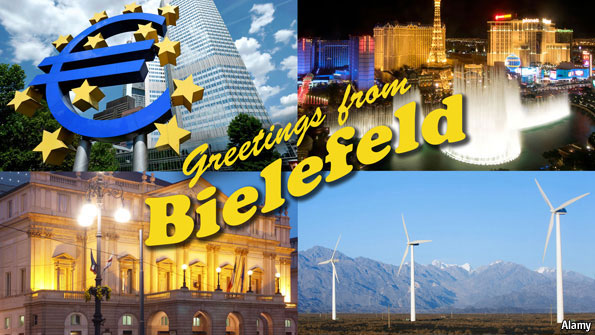
THE European Central Bank controls Europe's currency from Frankfurt, Germany's financial centre. Beckhoff Automation, in a bucolic corner of Westphalia, controls the bank. Or more precisely, its devices control the bank's lighting and ventilation. Other Beckhoff gizmos raise the curtain and dim the lights at Milan's Teatro alla Scala. Yet more are embedded in luxury sailboats, in dancing fountains outside Las Vegas hotels and in half the wind turbines made in China.

Omnipresent but obscure, family owned but by no means puny, Beckhoff is among thousands of “hidden champions” that account for much of Germany's prowess as a manufacturer and exporter. Its sales leapt 34% to €465m ($608m) last year. It is aiming for €2 billion by 2020. Beckhoff exports more than half its output. But its manufacturing is mainly in high-wage, rule-bound Germany.

Largely thanks to its Beckhoffs, Germany looks like a bright exception to the dispiriting rule among developed economies. True, its economy contracted more than those of most rich countries during the 2008-09 world recession (see chart 1). But the jobless rate rose by less than in all the others, peaking at 7.9%. And nobody talks about downgrading Germany's AAA credit rating; it can borrow money for practically nothing.

Envy and emulation

Not all the news is good. The economy shrank in the final quarter of 2011; and even if first quarter figures do not reveal Germany itself to be in recession, its economy will continue to suffer the drag of recession elsewhere in the euro area and a slowdown in developing countries. But just 1% growth is enough to create jobs, according to Bert Rürup, a former chairman of the government's council of economic “wise men”. In a book written with a journalist, Dirk Heilmann, “Fat Years: Why Germany has a Brilliant Future”, he giddily predicts that by 2030 Germany will become the world's richest large country in terms of income per head.

Such success does not bring universal admiration. Germany is hated in parts of Europe for demanding growth-crushing austerity as the price for supporting the euro. Greek tabloids have depicted Angela Merkel, the chancellor, in Nazi uniform. A current account surplus larger than China's as a share of GDP is a badge of pride for many Germans (see chart 2). But economists such as Simon Tilford of the Centre for European Reform (CER) accuse them of “fetishising exports” while low wage growth depresses their demand for goods from other countries. When in 2010 Christine Lagarde, then France's finance minister and now head of the International Monetary Fund, questioned whether Germany's export-dependent model was “sustainable” she spoke for many.

Yet there is also a great deal of admiration. Spain's education minister is looking into Germany's “dual system” of vocational training, which combines classroom instruction with work experience. John Cridland, director of the Confederation of British Industry, wants Britain “to have its own version of the German Mittelstand”, ie, firms like Beckhoff. Nicolas Sarkozy began his campaign for re-election as France's president sounding as if he would gladly swallow the model whole. Germany prioritised “jobs, jobs, jobs,” he said. “If it worked for them, why wouldn't it work for us?”

But is the model copiable? After a few days in East Westphalia-Lippe (now marketing itself to the world as OWL) you wonder. Beckhoff and its peers have global ambitions but their business culture has deep provincial roots. They look back as much as forward. “We have existed since 1825 and have been doing the same thing since then,” says Dieter Brand, chairman of the Sparkasse, or savings bank, in Bielefeld, the region's biggest town. In some senses the same is true of his corporate customers. Germany may have reformed and rearticulated its model in recent years. But the underlying skeleton is ancient, and perhaps inimitable.


jeudi 17 mars 2016

Tanzania Economy 2016

Tanzania Economy 2016 

Economy - overview:

Tanzania is one of the world's poorest economies in terms of per capita income, however, it has achieved high overall growth rates based on gold production and tourism. Tanzania has largely completed its transition to a liberalized market economy, though the government retains a presence in sectors such as telecommunications, banking, energy, and mining. The economy depends on agriculture, which accounts for more than one-quarter of GDP, provides 85% of exports, and employs about 80% of the work force. The World Bank, the IMF, and bilateral donors have provided funds to rehabilitate Tanzania's aging economic infrastructure, including rail and port infrastructure that are important trade links for inland countries. Recent banking reforms have helped increase private-sector growth and investment, and the government has increased spending on agriculture to 7% of its budget. The financial sector in Tanzania has expanded in recent years and foreign-owned banks account for about 48% of the banking industry's total assets. Competition among foreign commercial banks has resulted in significant improvements in the efficiency and quality of financial services, though interest rates are still relatively high, reflecting high fraud risk. All land in Tanzania is owned by the government, which can lease land for up to 99 years. Proposed reforms to allow for land ownership, particularly foreign land ownership, remain unpopular. Continued donor assistance and solid macroeconomic policies supported a positive growth rate, despite the world recession. In 2008, Tanzania received the world's largest Millennium Challenge Compact grant, worth $698 million, and in December 2012 the Millennium Challenge Corporation selected Tanzania for a second Compact. Dar es Salaam used fiscal stimulus and loosened monetary policy to ease the impact of the global recession. GDP growth in 2009-13 was a respectable 6-7% per year due to high gold prices and increased production.

GDP - composition, by sector of origin:
agriculture: 27.6%
industry: 25%
services: 47.4% (2013 est.)

Agriculture - products:
coffee, sisal, tea, cotton, pyrethrum (insecticide made from chrysanthemums), cashew nuts, tobacco, cloves, corn, wheat, cassava (manioc, tapioca), bananas, fruits, vegetables; cattle, sheep, goats

Industries:
agricultural processing (sugar, beer, cigarettes, sisal twine); mining (diamonds, gold, and iron), salt, soda ash; cement, oil refining, shoes, apparel, wood products, fertilizer

Industrial production growth rate:
7.4% (2013 est.)
country comparison to the world: 30
[see also: Industrial production growth rate country ranks ]

Labor force:
25.59 million (2013 est.)
country comparison to the world: 27
[see also: Labor force country ranks ]

Labor force - by occupation:
agriculture: 80%
industry and services: 20% (2002 est.)

Madagascar Economy

Madagascar Economy 

Madagascar has performed relatively well in limiting its trade barriers, encouraging an agriculture industry that accounts for 80 percent of the economy. However, recent years’ progress on institutional development and economic liberalization has been uneven and often disrupted by political volatility.

Economic Freedom Snapshot
2016 Economic Freedom Score: 61.1 (down 0.6 point)
Economic Freedom Status: Moderately Free
  • Global Ranking: 87th
  • Regional Ranking: 9th in Sub-Saharan Africa
  • Notable Successes: Trade Freedom
  • Concerns: Property Rights, Corruption, and Regulatory Efficiency
  • Overall Score Change Since 2012: –1.3
Poverty remains a serious challenge, and efforts to promote private-sector job growth and business development are undermined by a weak judicial system and corruption. Poor governance exacerbated by political instability and a deteriorating rule of law continues to undermine prospects for long-term economic development.


Background 

The former French colony of Madagascar, after decades of military coups, political violence, and corruption, has stabilized in recent years. Hery Rajaonarimampianina was elected president in January 2014 after years of political instability sparked by a 2009 coup. In January 2015, a general, Jean Ravelonarivo, succeeded Roger Kolo as prime minister when Kolo and his government resigned after less than a year in office. Given the country’s improved stability, international organizations and foreign donors have restored ties that had been severed following the 2009 coup. Madagascar’s economy is largely agricultural. Sitting just off the east coast of Africa, the country is highly vulnerable to natural disasters and weather shocks. The World Bank estimates that 92 percent of Malagasy live on less than $2 a day.


Open Market

Madagascar’s average tariff rate is 6.4 percent. Foreign and domestic investors are treated equally under the law. State-owned enterprises operate in the energy, air transportation, and other sectors of the economy. Despite some progress, the relatively high cost of financing hinders entrepreneurial growth, particularly for small and medium-size firms. Capital markets remain underdeveloped.

Africa's poorest country revealed

Africa's poorest country revealed


In 2000, Zimbabwe was one of the wealthiest countries in Sub-Saharan Africa on a wealth per capita basis, ranked ahead of the likes of Nigeria, Kenya, Angola, Zambia and Ghana, but now, it is ranked the poorest.

Vote rigging, the lack of respect for ownership rights, violence, absence of press freedom are some of the reasons that have been cited for the Southern African country’s collapse and ultimate malaise.

The 3rd Annual Africa Wealth Report says, people living in Zimbabwe are the poorest on the continent having on average US$200 each. The amount most public servants are earning.  

“Ownership rights are key to facilitating wealth creation. In Zimbabwe, business owners are unsure as to whether their businesses or property will still belong to them a year down the line, which creates a situation where no one will take the chance of investing in the country.," said the report.

Press freedom has also been at the centre of the Zimbabwe crisis.

“The banning of the independent media in the early 2000s, which has created a situation where it is impossible for investors to tell what is happening there. Foreign journalists are also not allowed inside Zimbabwe. The only TV footage that comes out of Zimbabwe comes from state-owned TV stations,” adds the report.

Zimbabwe has however relaxed a number of its restrictive media laws over the past few years. A number of international media houses have representives within the country.

The report surveyed 20 countries - all of them saw a surge in per capita wealth during the period between 2000 and 2015, apart from Zimbabwe.

Wealth Per Capita

While Zimbabwe is collapsing the Island country of Mauritius is rising. The country saw the wealthiest individuals in Africa with US$21,700 in wealth per person.

The success of Mauritius has been attributed to secure ownership rights that has seen a large number of wealthy individuals moving there over the past decade.

“Low taxes which encourage business formation and appeal to retirees. Company and personal income tax rates are only 15%, with no inheritance or capital gains tax.” 


Ethiopia’s impressive economic growth

Ethiopia’s impressive economic growth


The country which is sub-Saharan Africa's fifth biggest economy is at the focal point of emerging economies' interest with various delegations of foreign investors seeking investment opportunities in the largest landlocked country in the continent.

“If you look at it [Ethiopia] from an economic stand point, I think Ethiopia is one of the countries that has become the quint essential embodiment of the Africa rising narrative,” Julians Amboko, research analyst at Stratlink Africa from CNBC Africa.

The country’s economic growth is principally attributed to intense government projects aimed at achieving its Millennium Development Goals (MDGs) as the country aims at becoming a middle income status by 2025.

“Look at the year between 2013 and 2014, the GDP growth was about 10.6 per cent, double digits. Kenya did only 4.8 per cent, Rwanda which has been a very stellar performer did only 7.9 per cent and therefore from that stunt point indeed investors must be looking at how they can tap into this market which is growing so fast,” Amboko said.

According to the country’s finance ministry, the Eastern Africa state’s economic growth is projected at 11 per cent per annum as the country seeks to maintain this rapid growth. The country has a grand five-year Growth and Transformation Plan which ran from 2010 and is expected to end by 2015 that foresees sustainable means of economic, social and environmental development.

 “Their [Ethiopia’s] grand transformational plan is to really strengthen the manufacturing sector of the country because Ethiopia is quickly emerging as a manufacturing hub in the region especially in regards to agro processing and textiles and therefore the focus on industrial parts is driven mainly by the governments focus on manufacturing as an engine for growth going forward,” Amboko explained.

Ethiopia has witnessed an increased contribution from the sector, particularly focused on increased production in sugar, textiles, leather products and cement.


Twitter Delicious Facebook Digg Stumbleupon Favorites More